Font Size:

The Origins of the City Guilds

In the absence of firm contemporary evidence this has to be a matter of some speculation. It would appear that the Church played a significant part in the early days. The connection between Church and Trade would appear to be a geographical one. In early times there were religious fraternities associated with particular saints who had chapels dedicated in their honour in local City churches. It was also the custom of various trades and crafts to group themselves in discreet locations within the City as evidenced by surviving street names; Bread Street, Goldsmiths Row, The Vintry etc. Such being the case, it is likely that a particular local religious fraternity would be composed largely of members of a particular trade or craft.

The pre-Reformation Companies were designated in their Charters as being a Guild in honour of a particular Saint and the Saint’s name took precedence over the trade in the charter. After the Reformation the emphasis was rather more on the trade aspects of the Guild although religion continued to play a significant part in their activities.

From their religious and fraternal beginnings the Guilds developed the business supervision of their trades and crafts. Such supervision is evident as early as the twelfth century and later became embodied in Charters and Ordinances, regulations concerning the binding and training of apprentices, the inspection of finished goods to ensure a quality standard (backed by the right to search) and the development of a ‘closed shop’ principle so that only freemen could carry on a particular trade or craft within the City and for a prescribed distance around it.

All this served to protect customers from poor quality goods, employers against bad workmen and workmen against bad employers. The early Guilds were in fact a combination of employer’s federation, trade union and friendly society as they were also devoted to assisting any of their members and their widows who may have fallen on hard times.

The height of the power of the Guilds was in the fifteenth and sixteenth centuries. As the economy of the country expanded maintenance of control became more difficult. Although new Guilds were formed in the seventeenth century, including the Clockmakers, their absolute powers were beginning to decline. By the end of the eighteenth century the Guilds’ original functions were largely inoperable although they have never legally been rescinded. However the City Companies, as the Guilds became known, were able to adapt to the changing conditions and they found new life in promoting general and technical education through charitable means related to their respective crafts. Many continued to take an interest in members and widows who were suffering hardship.

Although in their original charters various names were used to describe a particular group of craftsmen e.g. ‘fraternity’, ‘commonalty’, ‘society’ and in the case of Clockmakers ‘ fellowship’ gradually the term ‘Company’ (meaning assembly) came to be adopted as the common title. The preceding word ‘Worshipful’ which formed part of the descriptive style of some of the early Guilds is strictly a courtesy title meaning ‘dignified’ or ‘honourable’.

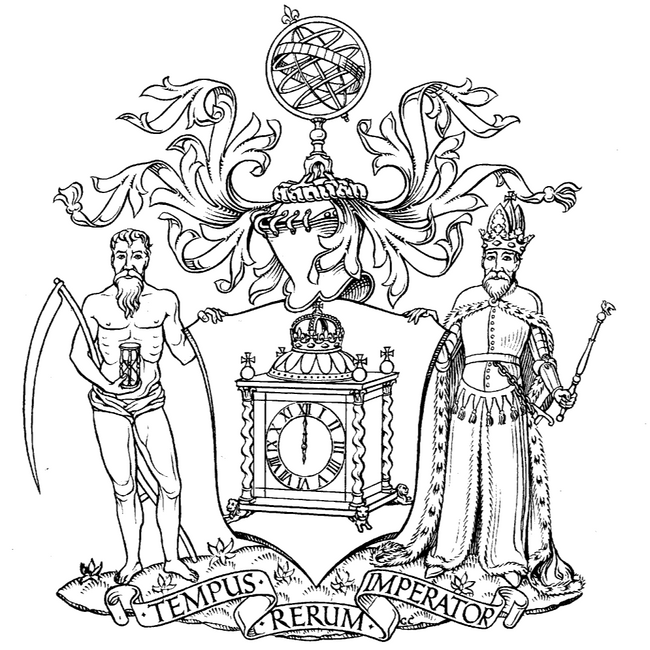
The term ‘Livery’ comes from the distinctive dress or livery originally worn by craft members on formal occasions. The colours were usually taken from the two chief tinctures in the Company’s coat of arms. In the case of Clockmakers they are gold and black.

topofpage top of page

WCC Members Login

Login
(WCC Liverymen & Freemen only)

WCC Members' Diary

Roger Smith FBHI

BHI Silver Medal awarded to Isle of Man based watchmaker Roger Smith. Roger explains his detailed finishing techniques in this video.

H M S Archer

Lt Michael Hutchinson RN, Commanding Officer of HMS Archer, has just sent us their latest newsletter. WCC mentioned on page 5.

Livery Company Profile Survey

Did you know? A recent survey shows that the 108 City of London Livery Companies, comprising 26,250 Liverymen, have affiliations to 153 schools and colleges, 65 churches, 216 regular and reserve units of the Armed Forces, and 101 cadet units. In 2010 they gave £41.85 million to charitable causes. The Mercers’ Company recently researched and compiled The 2011 Livery Profile Survey – click to see the full report (two pages).

Dr George Daniels CBE FBHI

A new book on the life and work of Dr George Daniels is being written by Michael Clerizo, and will be launched at The Basle Fair. Michael would welcome contributions, anecdotal or otherwise, from members of the Company. He can be contacted at Clerizo@aol.com.

HMS Protector

HMS Protector - with whom WCC is affiliated - sailed from Portsmouth on 28th November 2011 and is now on her way to Antarctica. Past Master Cdr Peter Linstead-Smith OBE RN and the Deputy Master, Howard Newman FBHI, visited HMS Protector on the 21st November to wish the Captain and the crew well and presented a bulkhead clock, to keep time in the Wardroom, as a gesture of goodwill from WCC. more » Ross Watton & Naval Broadsides)

National Benevolent Society of Watch & Clock Makers