Dr Philip Woodward DSc was presented with the Tompion Medal by the Master in November 2009, "for services to precision mechanical horology".
Regulations Governing the Award of The Tompion Medal state:-
That the Company of Clockmakers in the City of London does commemorate outstanding achievements in horology by the award of a Gold Medal. That the medal be awarded at the discretion of the Court from time to time but not more than once in any calendar year, and that in the selection of the recipient of the award no regard will be paid to nationality. It was decided that the Medal should be known as the Tompion Gold Medal in memory of Thomas Tompion, called the Father of English Clock and Watch Making, Master of the Company in 1703.

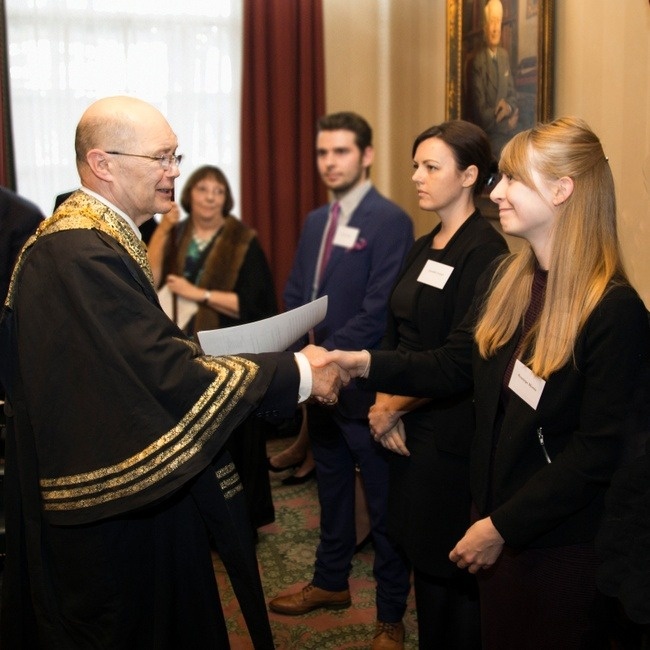
David Thompson FBHI, Senior Curator of Horology at The British Museum, receiving The Harrison Medal from The Master at the Clockmakers' Livery Dinner at Goldsmiths' Hall in November 2009
Regulations Governing the Award of The Harrison Medal
That the Company of Clockmakers in the City of London do commemorate outstanding achievements in propagating knowledge of the history of clockmaking and its appreciation, by the award of a Medal named after the illustrious John Harrison. That the medal be awarded at the discretion of the Court from time to time.
The recipients of The Tompion Medal
1954 – Mr W.H. Shortt for the invention, in 1925, of the Shortt Free Pendulum which, for over thirty years remained the standard timekeeper at observatories throughout the world.
1955 – Mr W.A. Morrison (USA) for work on the development of the quartz crystal clock.
1957 – Dr Louis Essen for his development of the Essen Ring Quartz-crystal oscillator, and of the first Atomic Clock of high precision.
1963 – Mr Max Hetzel (a Swiss citizen working in the USA) for his development of the tuning fork as a method of timekeeping in a wrist watch (Bulova Accutron).
1980 – Dr George Daniels CBE for outstanding feats of craftsmanship, skill, innovation and artistry in designing and making watches with mechanical movements, of absolute perfection; backed by his attributes as an author of horological books and publications.
1992 – Dr L. V. Morrison and Dr R. Stephenson for their work on variations in the rate of the rotation of the earth.
1996 – Dr Bernard Guinot for his contributions to the implementation of Co-ordinated Universal Time (OTC).
2000 – Dr Patrick Gill for his contributions to the pursuit of an ultimate frequency standard, and to education in horology.
2002 – Dr Terry Quinn FRS for his work at the NPL and at the BIPM in Sèvres, on the science of measurements in general.
2005 – Mr Derek Pratt for outstanding contributions to horology; a top class watch and clock maker; his ingenuity, technical ability and curiosity have helped to solve a variety of prototype and production problems; a supreme artist-craftsman.
2007 – Mr Anthony Randall. An outstanding horologist who has made an immense contribution to horology over a period of more than forty years.
2009 – Dr Philip Woodward DSc for services to precision mechanical horology.
The recipients of The Harrison Medal
2002 – Jonathan Betts for his work in the furtherance of horological knowledge and its dissemination in the wider field at the National Maritime Museum, and elsewhere.
2004 – Dava Sobel for her internationally acclaimed book on John Harrison: ‘Longitude’.
2006 – Sir Arnold Wolfendale for his outstanding work and inspirational leadership in initiating and master-minding the commemoration of John Harrison by a memorial in the nave of Westminster Abbey.
2007 – Mr William Andrewes – Much of his distinguished career and internationally acclaimed literary work has been spent in propagating knowledge of the great John Harrison and his works and celebrating his achievements.
2009 – Mr David Thompson for services to the history and technology of horology.